
Every agency talks about SEO. They throw around terms like ‘keywords,’ ‘backlinks,’ and ‘algorithm updates.’ They show you charts with lines going up. And at the end of the meeting, you’re still not sure what they actually do—or why it should cost $2,000 a month.
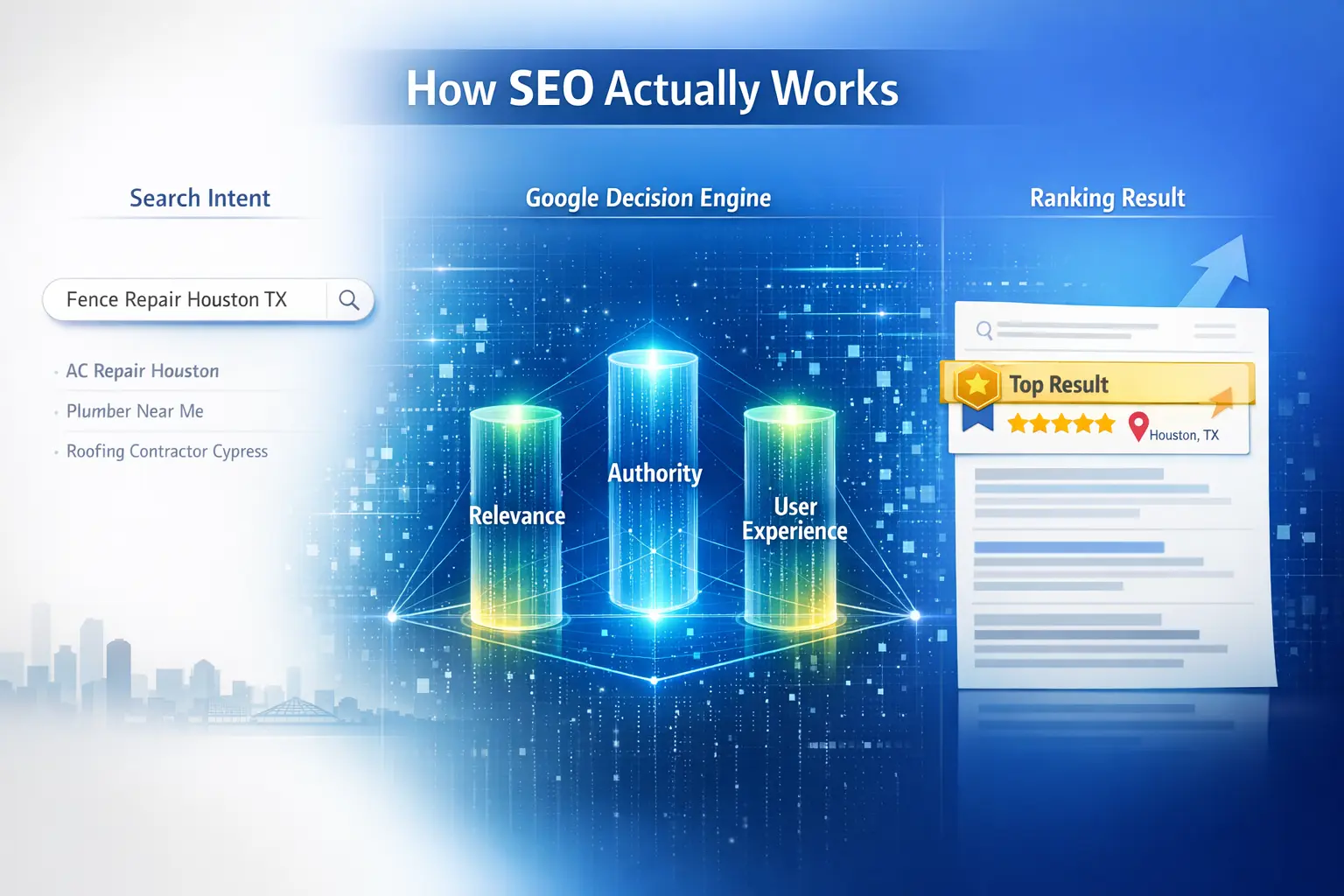
Here’s the truth: SEO is simpler than most agencies make it sound. It’s essentially convincing Google that your website is the best answer for what someone searches. Google looks at three things: Is your content relevant to the search? Do other websites vouch for you? And do people who visit your site actually find what they need? Everything else, keywords, meta tags, backlinks, these are just the tactics we use to prove those three things. Let me break it down.
The Short Answer: How Does SEO Work?
SEO (Search Engine Optimization) works by optimizing your website so Google ranks it higher in search results. Google’s algorithm evaluates:
- Relevance, does your page match what someone searched?
- Authority, do other trustworthy sites link to you?
- User experience, do visitors engage with your content?
- SEO improves all three through content optimization, technical fixes, and building quality backlinks.
Step 1: How Google Finds Your Website
Before Google can rank you, it needs to know you exist. This happens through ‘crawling’ – Google sends out bots (called ‘spiders’) that follow links across the internet, discovering new pages.
Think of it like this: The internet is a city, and Google’s bots are delivery drivers. They follow roads (links) to find buildings (websites). If your building has no roads leading to it, the drivers will never find it.
What this means for you:
- Your site needs to be technically accessible, no broken links, proper site structure, fast loading
- You need a sitemap telling Google all the pages you want found
- Links from other websites help Google discover you faster
Step 2: How Google Decides Who Ranks Where
Once Google knows your pages exist, it evaluates them against everyone else competing for the same searches. Google’s algorithm considers hundreds of factors, but they boil down to four main categories:
| Factor | In Plain English | Houston Example |
|---|---|---|
| Relevance | Does your page actually answer what someone searched for? | If someone searches ‘AC repair Cypress TX,’ Google checks if your page talks about AC repair in Cypress—not Dallas, not general HVAC tips. |
| Authority | Do other websites link to you as a trusted source? | If the Houston Chronicle links to your roofing company as a local expert, Google sees that as a vote of confidence. |
| User Experience | When people visit, do they stay and engage—or leave immediately? | If visitors spend 3 minutes reading your page vs. 10 seconds before clicking back, Google notices. |
| Technical Health | Can Google actually find and read your pages? | Broken links, slow loading, mobile unfriendliness—these prevent Google from properly indexing your site. |
What SEO Agencies Actually Optimize: On-Page Elements
When agencies talk about ‘on-page SEO,’ they mean optimizing elements directly on your website. Here’s what they’re working on and why it matters:
| Element | What It Is | How to Optimize It |
|---|---|---|
| Title Tags | The headline Google shows in search results | Include your main keyword + location. ‘AC Repair Houston | 24/7 Emergency Service | [Company]’ |
| Meta Descriptions | The 2-line preview under your title in search | Write compelling copy that makes people want to click. Include your keyword naturally. |
| Headers (H1, H2, H3) | The headlines and subheadings on your actual page | One H1 per page with your main keyword. H2s for sections. Makes content scannable. |
| Content | The actual text, images, videos on your page | Answer the question someone searched. Be comprehensive. Use your keywords naturally—not stuffed. |
| Internal Links | Links from one page on your site to another | Connect related pages. Helps Google understand your site structure and spreads authority. |
Local SEO: Why Houston Businesses Need It
When someone searches ‘plumber near me’ or ‘fence company Cypress TX,’ Google shows local results, the map pack with 3 business listings. This is local SEO, and for Houston service businesses, it’s often more important than traditional rankings.
| Local Factor | What It Means | Why It Matters |
|---|---|---|
| Google Business Profile | Your free business listing on Google Maps | This is often the first thing local customers see. Complete profiles rank higher in map results. |
| NAP Consistency | Name, Address, Phone matching everywhere online | Inconsistent info confuses Google. Same exact details across all directories matters. |
| Local Citations | Your business listed on Yelp, BBB, industry directories | More legitimate listings = more trust signals to Google about your location and business. |
| Reviews | Customer reviews on Google and other platforms | Quantity, quality, and recency of reviews directly impact local rankings. |
Backlinks: The Votes That Build Your Authority
A backlink is when another website links to yours. Google sees each link as a ‘vote of confidence’—another site saying ‘this page is worth reading.’
But not all links are equal:
- Valuable links:
Local news sites, industry publications, business directories, chamber of commerce, complementary businesses - Harmful links:
Spam sites, link farms, unrelated foreign websites, paid link schemes
Quality matters more than quantity. One link from the Houston Chronicle is worth more than 100 links from random blogs. This is why legitimate SEO agencies focus on earning links through quality content and outreach, not buying them.
Frequently Asked Questions About SEO
How long does SEO take to work?
Most businesses see meaningful results in 3-6 months. You’ll see small improvements (better rankings for long-tail keywords, increased impressions) in month 2-3. Significant traffic and lead increases typically happen around month 4-6. Competitive keywords can take 6-12 months.
Can I do SEO myself?
Yes, if you have 10+ hours per week to learn and implement. Start with Google’s own guides and your Google Search Console data. Many business owners handle basic on-page SEO but hire help for technical SEO and link building, the more complex aspects.
Why isn’t my website ranking even though I have good content?
Content is just one piece. Common reasons: technical issues preventing Google from finding your pages, no backlinks from other sites, competitors have stronger domain authority, or your content isn’t optimized for the right keywords. A technical audit reveals the specific problem.
Do I need SEO if I’m already doing Google Ads?
They serve different purposes. Ads give immediate visibility but stop when you stop paying. SEO builds long-term organic traffic that continues growing. Most Houston businesses benefit from both, Ads for immediate leads while SEO builds momentum.
What’s the difference between SEO and local SEO?
SEO optimizes for general search rankings. Local SEO specifically targets map pack results and location-based searches. For Houston service businesses, local SEO is often more important, that’s where customers searching ‘near me’ will find you.
Want to See How Your Site Stacks Up?
Now you understand how SEO works, not the jargon version, but what’s actually happening behind the scenes. The question is: how does your site measure up?
We offer free SEO audits for Houston businesses. We’ll check your technical health, on-page optimization, local SEO setup, and backlink profile. You’ll get a clear picture of where you stand and what it would take to improve.